
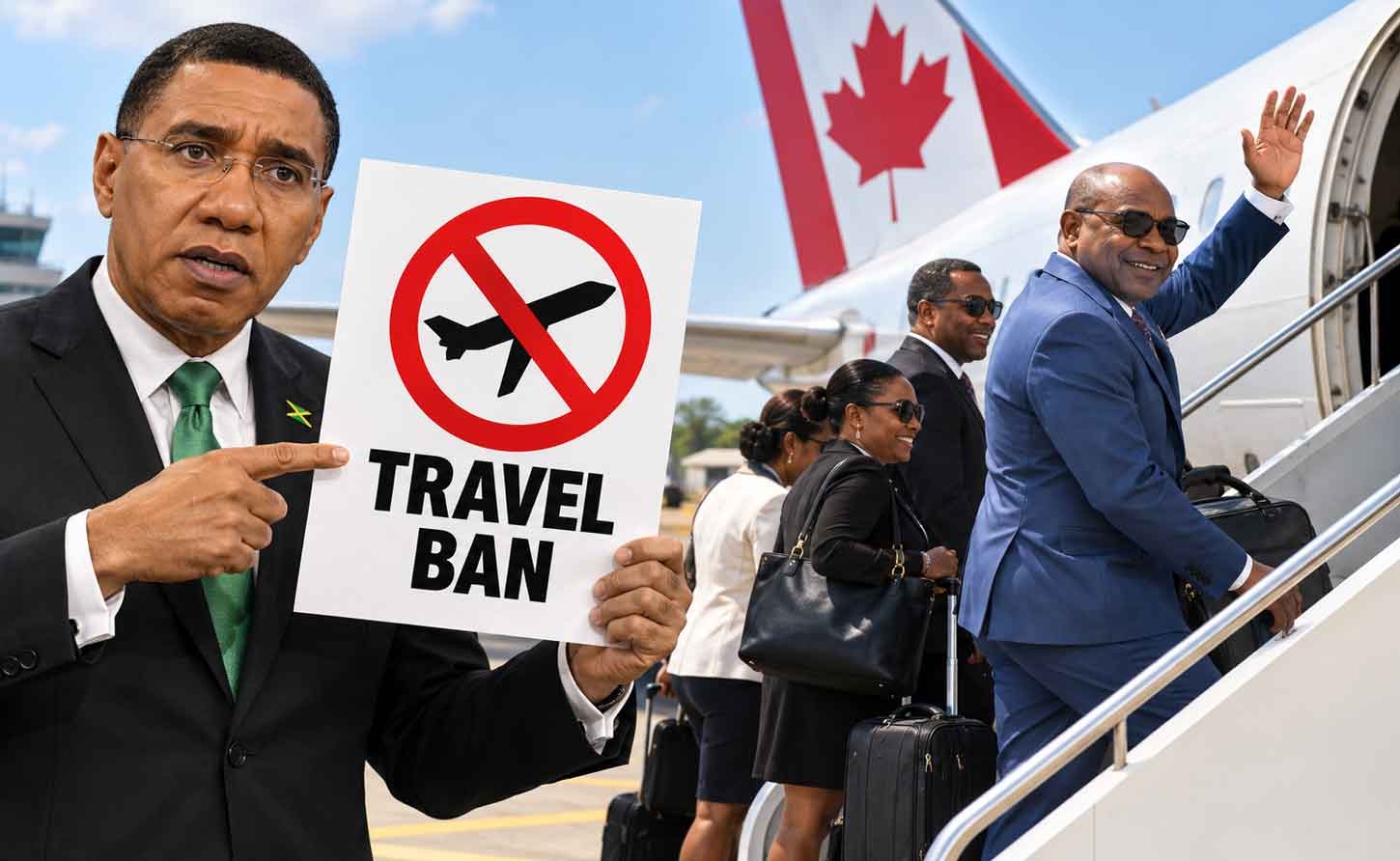
Five days after the Prime Minister and his Tourism Minister dined at The Plaza in New York, Jamaica House froze all official overseas travel until March. Two days after that, Edmund Bartlett boarded a flight to Toronto. He is almost certainly within the rules. The problem is that nobody can see them.
MONTEGO BAY, Jamaica, October 23, 2026 | Calvin G Brown — Tourism Minister Edmund Bartlett departed the island on Friday for a five-city swing through Canada, 48 hours after the Government declared an immediate moratorium on official overseas travel across the entire public sector, from Cabinet ministers to board members, until March 31, 2027.
The sequence is awkward. On Friday, October 16, Prime Minister Dr Andrew Holness and Bartlett were in Manhattan for the American Friends of Jamaica's 45th Hummingbird Gala at The Plaza Hotel, where Holness presented Sandals executive chairman Adam Stewart with the International Achievement Award and Bartlett handed actress Sheryl Lee Ralph the International Humanitarian Award. The evening raised more than US$900,000 for Jamaican causes, according to the organisers.
On Wednesday, October 21, Cabinet Secretary Audrey Sewell issued a four-page memorandum to the Financial Secretary and permanent secretaries suspending all official travel abroad. It applies regardless of whether the trip is paid for by the Treasury, a public body or an outside sponsor, and it orders every previously approved trip to be reviewed. "The Government must lead by example," the document says, in directing scarce resources to the country's most urgent priorities.
On Friday, October 23, Bartlett, Director of Tourism Donovan White and a Jamaica Tourist Board team left for Toronto, Calgary, Edmonton, Winnipeg and Montreal, with a return date of October 30.
The exemption nobody announced
The memorandum is not, in fact, an absolute ban. According to the Gleaner, which obtained the document, it carves out five exception categories: post-Melissa reconstruction and recovery, national security, standing bilateral and multilateral engagements, emergencies — and "essential tourism promotions."
Bartlett's mission plainly fits the last of these. But the memo is equally clear that fitting a category is not the same as being cleared. Every exempted trip must be supported by written justification establishing why it is necessary, why it cannot be done virtually, how many people must go, what it will cost and what it is expected to deliver, with prior written approval from the Cabinet Secretary.
That is a sensible process. It is also, for the moment, an invisible one. No public statement from Jamaica House, the Office of the Cabinet or the Ministry of Tourism has confirmed that the Canada trip went through it, who signed off, how large the delegation is, or what it costs.
The Jamaica Observer's own report on the moratorium noted that the circumstances for exemption "were not detailed," and the Government's first public defence of the policy, issued the same day by State Minister Abka Fitz-Henley, did not mention the tourism carve-out at all.
WiredJa is not suggesting the minister is in breach. The point is narrower and, arguably, more important: the public was told of a blanket freeze and left to discover the exceptions from a leaked document, on the same day the most prominent exception walked through the departure gate.
The public was told of a blanket freeze and left to discover the exceptions from a leaked document, on the same day the most prominent exception walked through the departure gate.
Government has to travel
Nobody serious argues that a tourism minister should stay home in the last week of October. The winter booking window for Canadian travel advisors is open now, and Canada is the market where Jamaica's airlift story is strongest. The JTB has announced roughly 400,000 Canadian seats for the 2026/27 winter season and projected a 62.1 per cent year-on-year increase in Canadian capacity for January to April 2027 — figures that cover different periods and, as eTurboNews cautioned in its report on the trip, should not be read as interchangeable. Seats are not arrivals; they have to be sold.
"Every seat that comes into Jamaica represents an opportunity," Bartlett said before leaving, adding that the opportunity is realised only when it becomes a booking and spending that reaches farmers, craft vendors, drivers and entertainers.
The itinerary is a working one: the JTB's Greater Toronto destination update seminar on Friday, the Diaspora Impact Awards and Black North Initiative gala on Saturday, product launches and trade media in the three western cities, and French-language television, radio and a meeting with Transat in Montreal. This is the trade engagement that moves bookings, and there is no credible virtual substitute for it.
There is also a documented record on Bartlett's travel. In January, the Auditor General's Department reviewed J$155 million in overseas trips by the minister and JTB officials, found no evidence of extravagance, confirmed the travel was authorised by Cabinet and stayed within budget. That matters, because the obvious rebuttal to this story — that the Tourism Ministry has form — does not survive contact with the audit.
Why the money question is real
The ban exists because the fiscal picture is bleak. Through the end of August, Jamaica had welcomed 2.34 million visitors and earned about US$2.5 billion, but arrivals were down 17 per cent and earnings down 18 per cent on 2025, a hole of roughly US$550 million, with about 30 per cent of hotel rooms still offline a year after Hurricane Melissa. The Jamaica Hotel and Tourist Association says more than six in ten insurance claimants are still waiting for full settlement as the peak season approaches.
Diaspora remittances have carried the foreign exchange account in the meantime. Finance Minister Fayval Williams told Parliament in September that net inflows reached US$3.12 billion in the year to March, with December 2025 the largest month on record. The Bank of Jamaica had already flagged in December that lower tourism inflows would be only partly offset by remittances.
The budget tells the same story. The Government broke its decade-long "no new taxes" stance in February, tabling measures worth J$29.4 billion for 2026/27, extended the J$11.4 billion annual draw on the National Housing Trust for another five years, and in September raised US$1 billion on the international market, with part of the proceeds explicitly earmarked for the current year's financing requirement. Holness has said further borrowing for reconstruction is likely beyond what the disaster reserve fund can cover.
Against that backdrop, a Treasury that tells a school principal she may not attend a fully sponsored conference in Miami is entitled to tell its ministers the same — and is obliged to explain, publicly and in advance, which ministers get a pass and why.
Substance or spin
The Opposition has gone further, with Finance spokesman Julian Robinson calling the moratorium "more performative" than practical and tying it to the row over the National Reconstruction and Resilience Authority's office lease and executive salaries. The PNP has asked the Government to publish the projected savings so that the public can judge whether the ban "is substance or spin."
Fitz-Henley dismissed that criticism as "superficial, shallow and misguided," noting that the Prime Minister had imposed a ministerial travel quota some years ago and describing the moratorium as the first of several efficiency measures still to be announced.
The test of whether the moratorium is policy or messaging is simple, and the Government has so far failed it: no savings figure has been published, no exemption list has been released, and the only official response to date has been a partisan rebuttal rather than a fiscal one. Until those numbers appear, the ban looks less like a Treasury measure than a press release.
Both can be right. A travel freeze during a reconstruction year is defensible policy; so is a tourism minister selling seats in the one market that is growing. What is not defensible is announcing the first without disclosing the exemptions to the second, and then saying nothing when the exemption is used within two days.
The fix is cheap and requires no travel: publish the exemption categories, publish the Cabinet Secretary's approvals as they are granted, and publish the cost and the purpose of each trip. Leading by example means letting the public see the example — including the seats at the top table.
First published by WiredJA. Republished by agreement.